MSK Architects acknowledges the Traditional Custodians of the lands on which we work and pay our respects to Elders past and present. We extend our respect to all Indigenous Peoples globally, as articulated in the United Nations Declaration on the Rights of Indigenous Peoples.
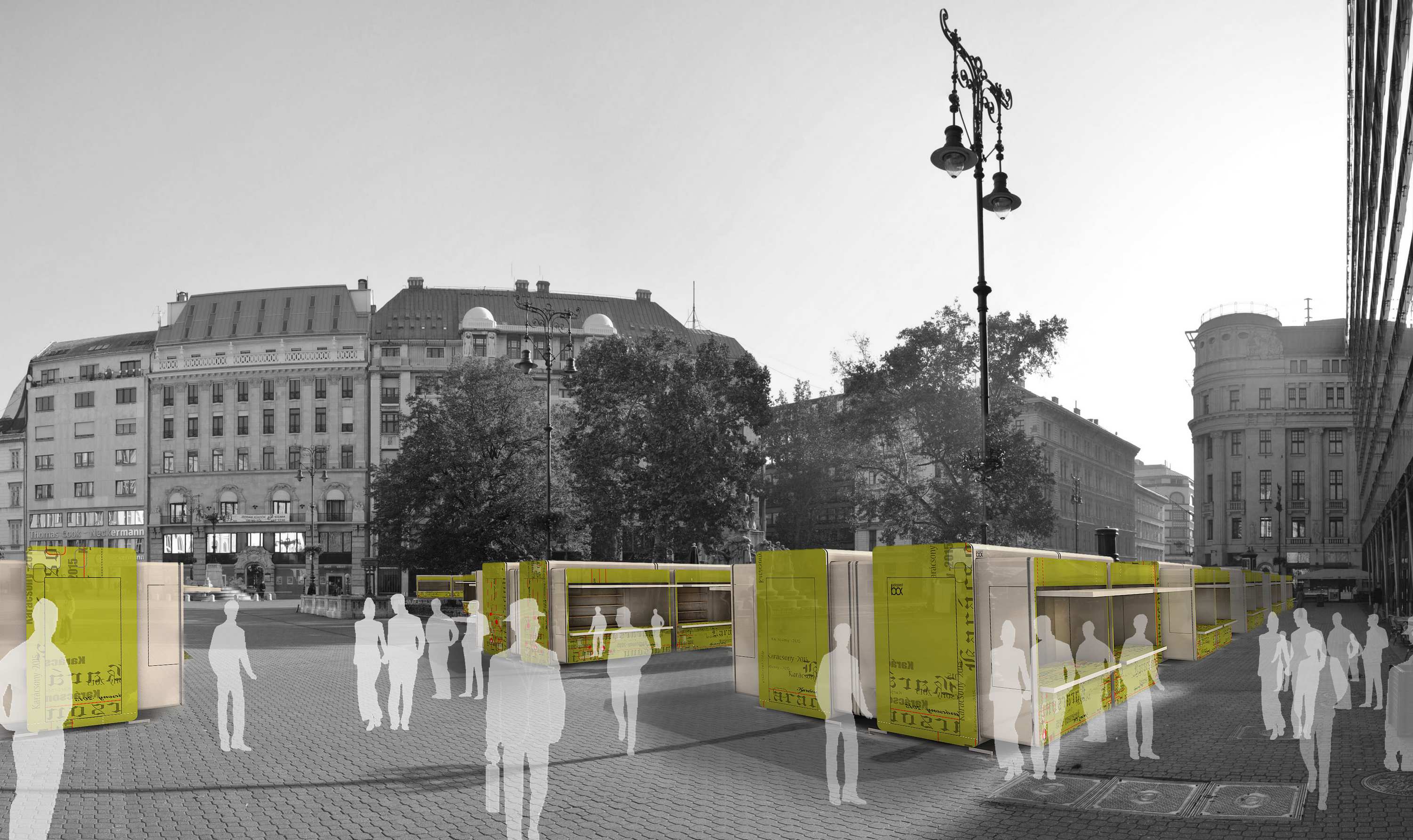
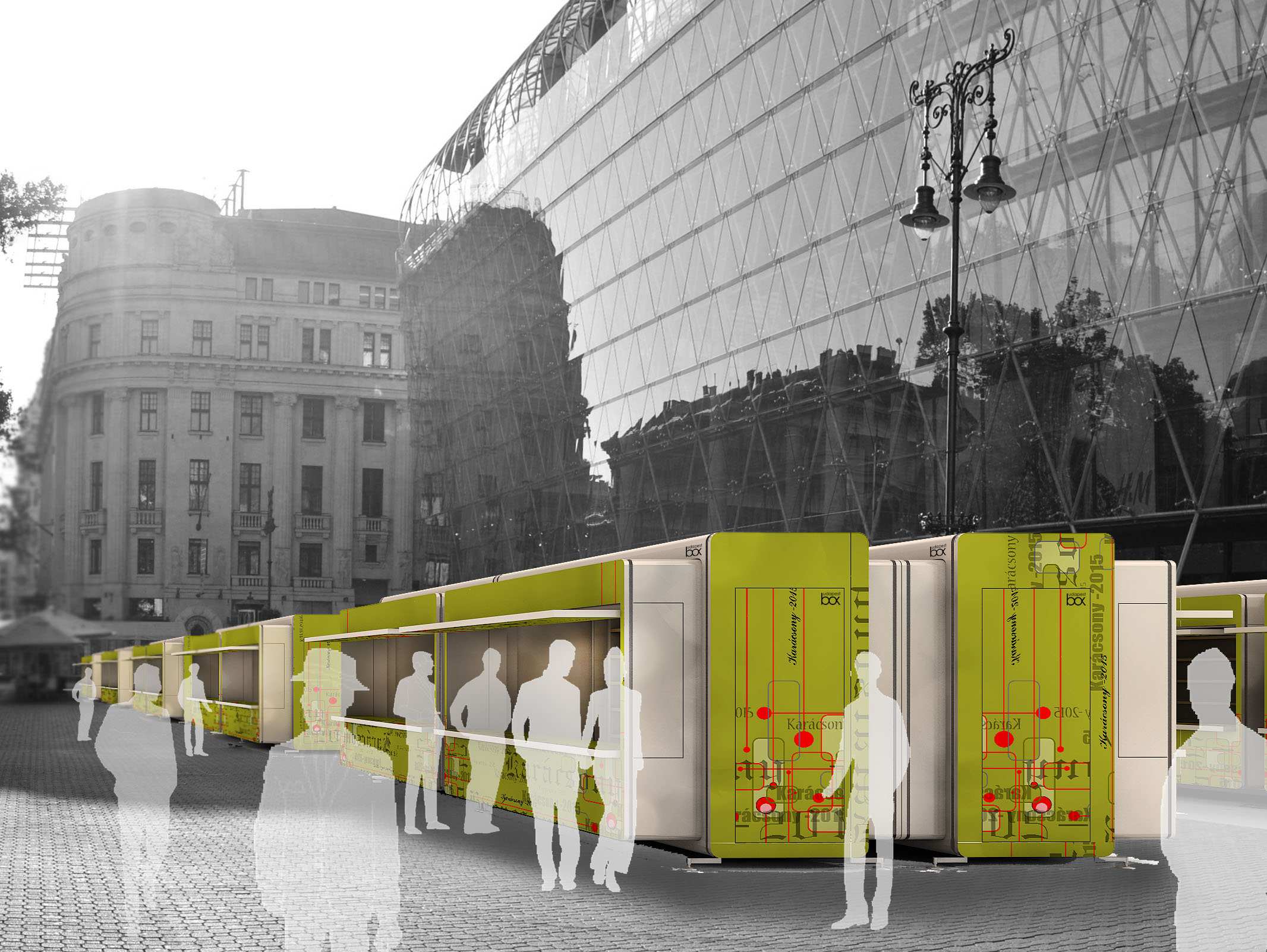
Budapest Box is a modular pavilion system developed as a first-prize competition entry, addressing the spatial, logistical, and environmental demands of temporary urban retail and hospitality structures. The system enables scalable configurations, rapid installation, and compact transport.
Budapest Box is a modular pavilion system developed as a first-prize competition entry, addressing the spatial, logistical, and environmental demands of temporary urban retail and hospitality structures. The system enables scalable configurations, rapid installation, and compact transport.
Budapest Box
Budapest Box is a modular pavilion system developed as a first-prize competition entry, addressing the spatial, logistical, and environmental demands of temporary urban retail and hospitality structures. The system enables scalable configurations, rapid installation, and compact transport.
Budapest Box
Budapest Box is a modular pavilion system developed as a first-prize competition entry, addressing the spatial, logistical, and environmental demands of temporary urban retail and hospitality structures. The system enables scalable configurations, rapid installation, and compact transport.
No items found.
Budapest Box is a modular architectural system designed to accommodate temporary commercial, hospitality, and event-related functions within dense urban public spaces.
Conceived as a first-prize-winning competition proposal, the project investigates how a limited number of highly resolved prefabricated elements can generate a wide range of spatial and functional configurations.
The System
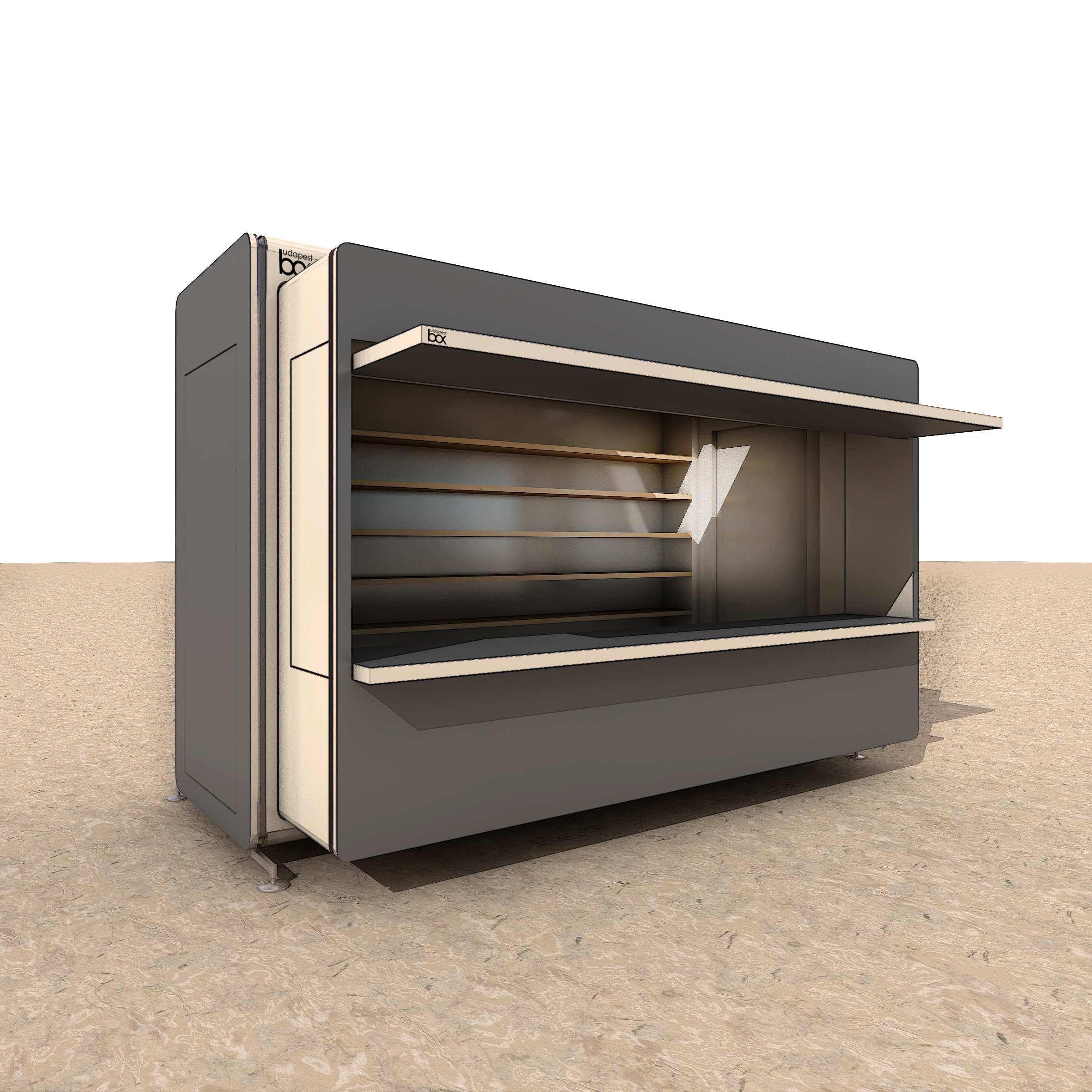
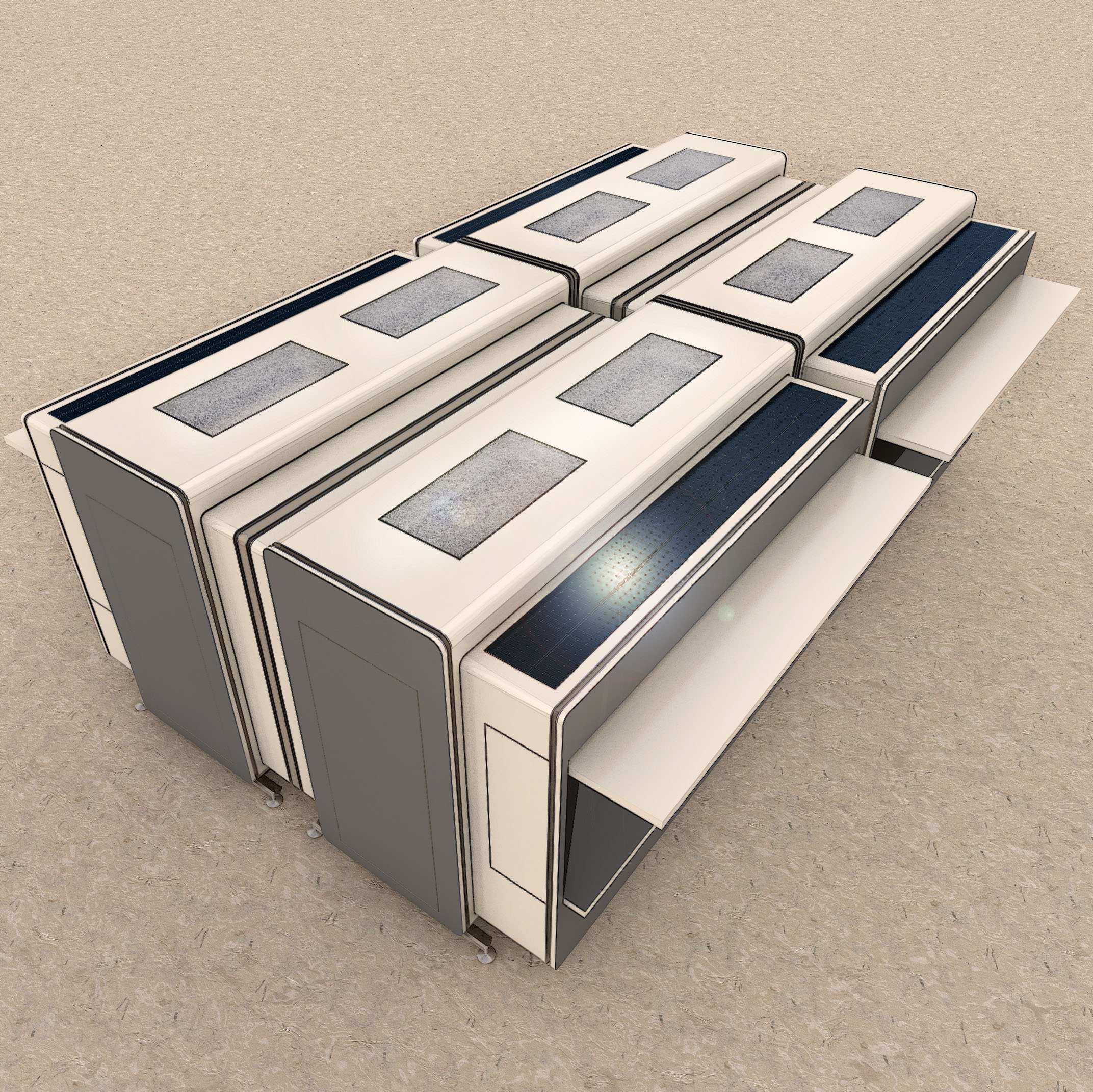
The system is organised around 4 m² and 8 m² base modules, which can be divided, mirrored, or linearly connected to form spatial units ranging from small kiosks to larger aggregated structures of 32 m² and beyond. Through the removal or reconfiguration of internal panels and storage elements, the combined modules can operate either as cellular units or as continuous open interiors, allowing adaptation to diverse uses including retail stalls, food preparation areas, kitchens, storage spaces, change rooms, or ancillary service functions.
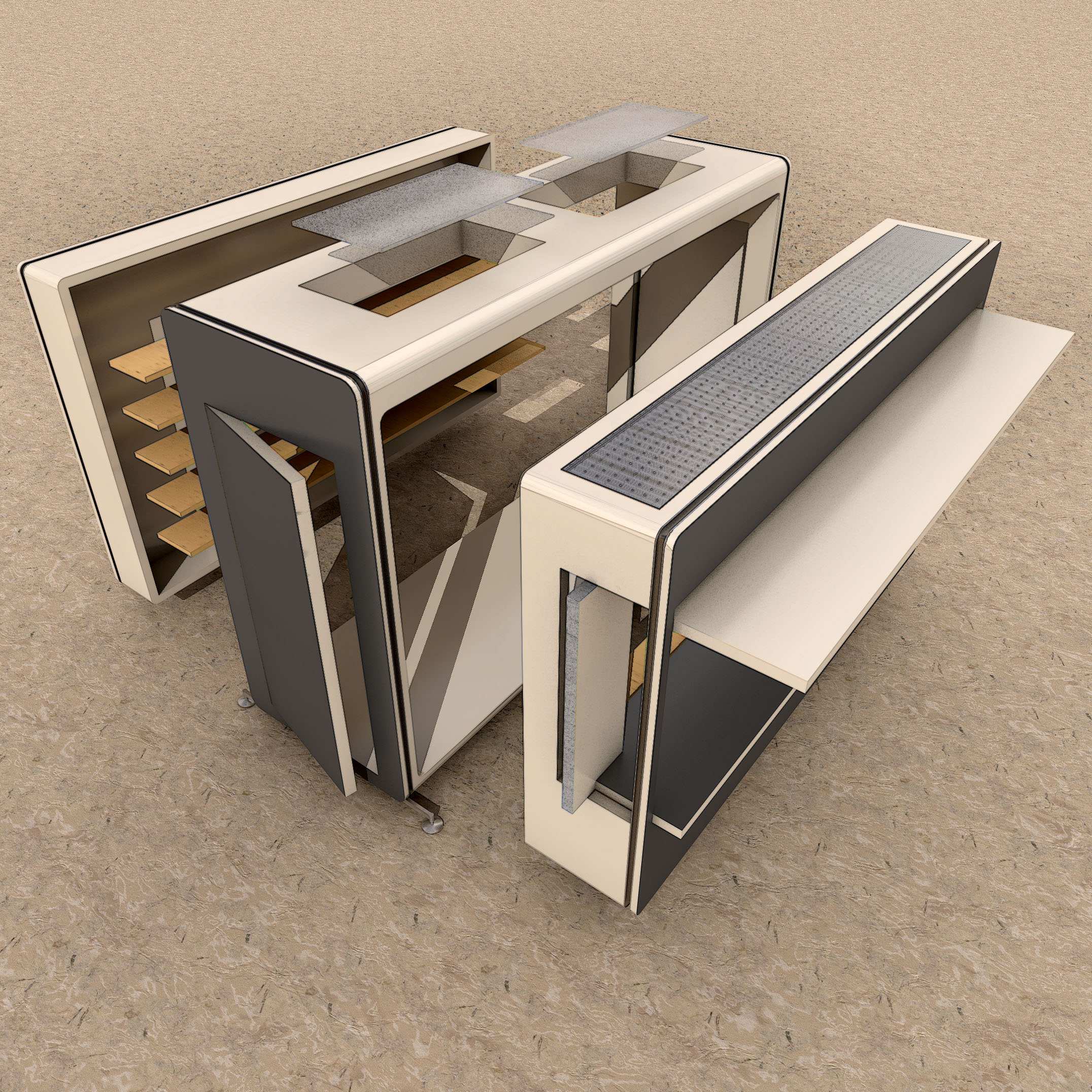
Exploded 3D image of our modular design
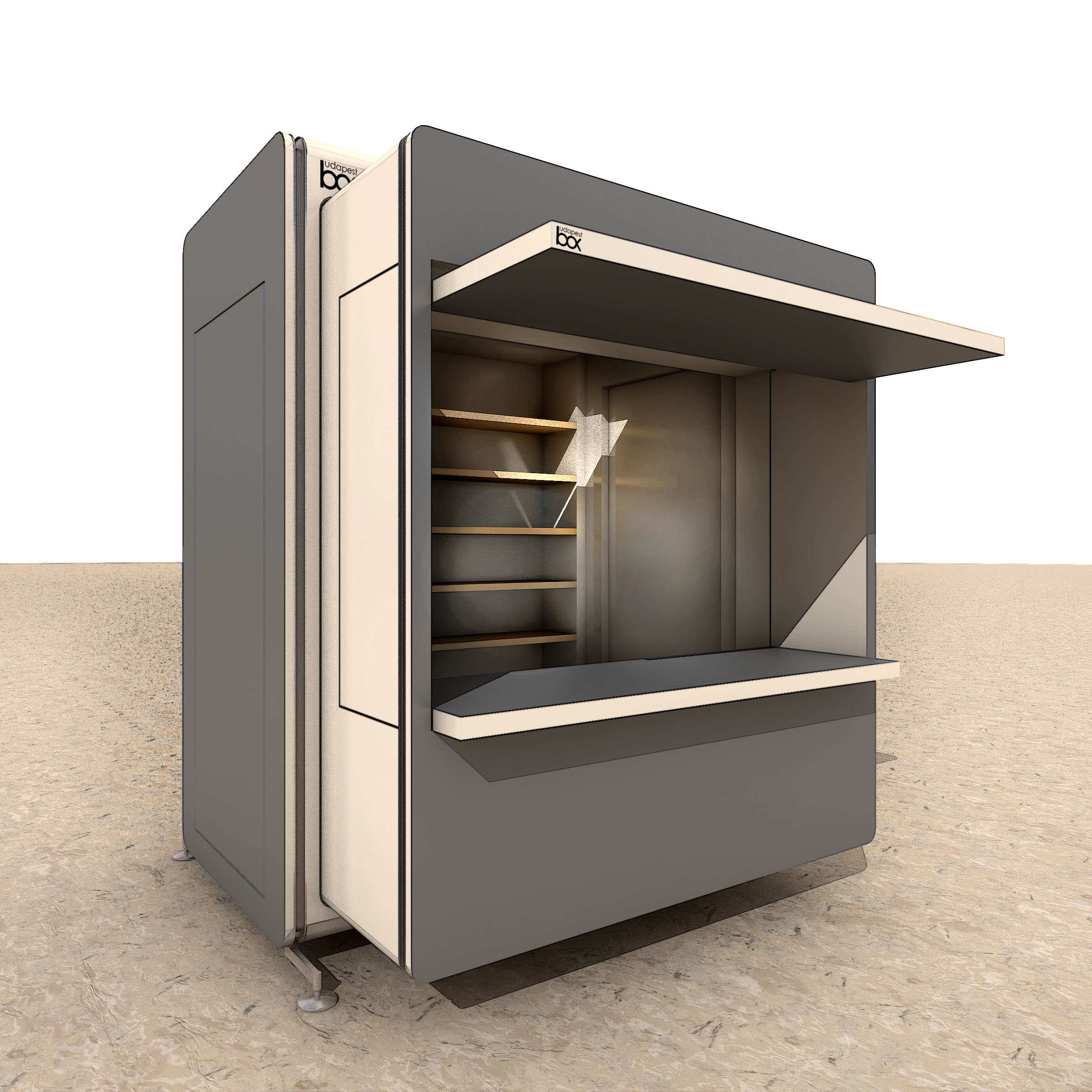
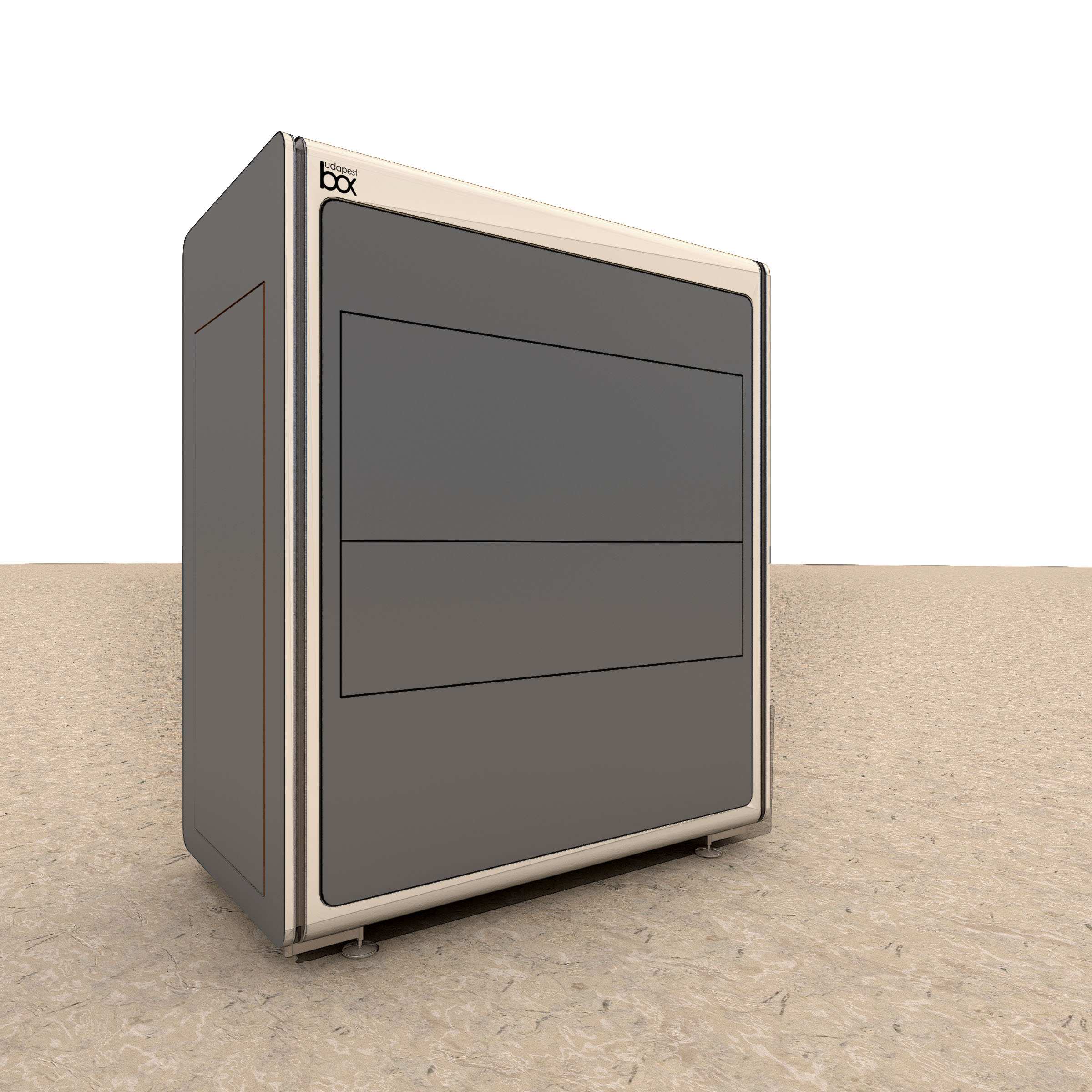
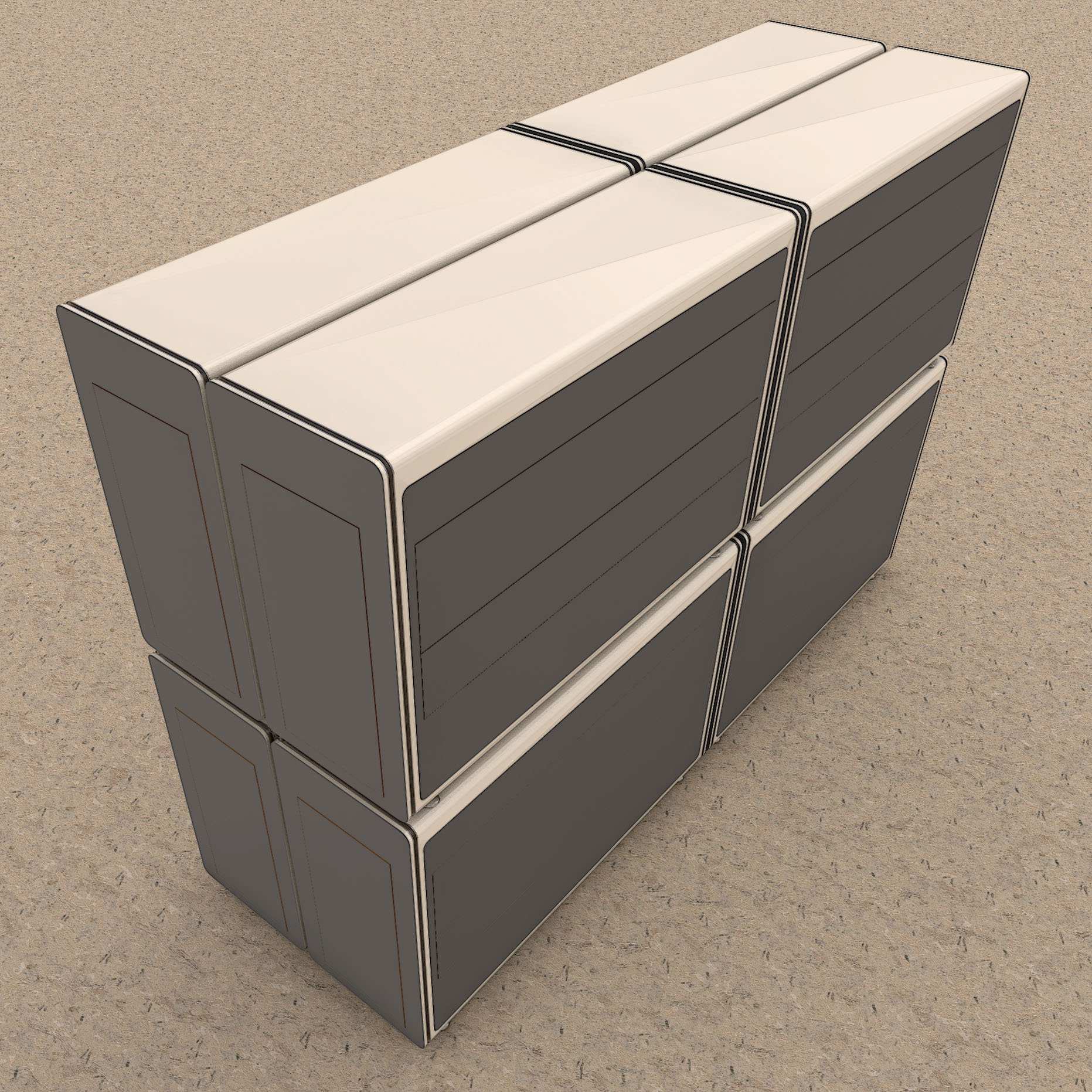
A central design ambition was to minimise on-site assembly and operational disruption. Each module incorporates a compact, bi-directional sliding drawer system, enabling all functional components to retract into the structural envelope. In its closed state, the pavilion becomes a self-contained, transportable volume that can be stacked, stored, and relocated with ease. This approach significantly reduces installation time and virtually eliminates the need for site-specific construction.
Materials
Material selection reflects priorities of robustness, longevity, and environmental responsibility. The structural shell is composed of laminated composite panels formed from resin-bonded wood and plastic fibres, reinforced internally with ribbing to achieve structural stability within a thin envelope. The perimeter is defined by an integrated corrosion-resistant steel C-profile, which performs multiple roles: water management, modular interconnection, and rail-based attachment for auxiliary elements such as signage, canopies, flags, or lifting mechanisms. The modular joints are designed to ensure watertight connections while allowing repeated assembly and disassembly.
Environmental considerations
Environmental performance is embedded within the architectural system rather than treated as an add-on. Optional translucent polycarbonate or acrylic roof lights introduce natural daylight deep into the interior, improving working conditions and reducing energy demand. The foldable canopy can integrate solar panels, supplying renewable energy for internal LED lighting. During transport and storage, these components are fully protected within the closed module. For seasonal adaptability, optional radiant heating elements can be incorporated to support winter operation without compromising spatial clarity or comfort.
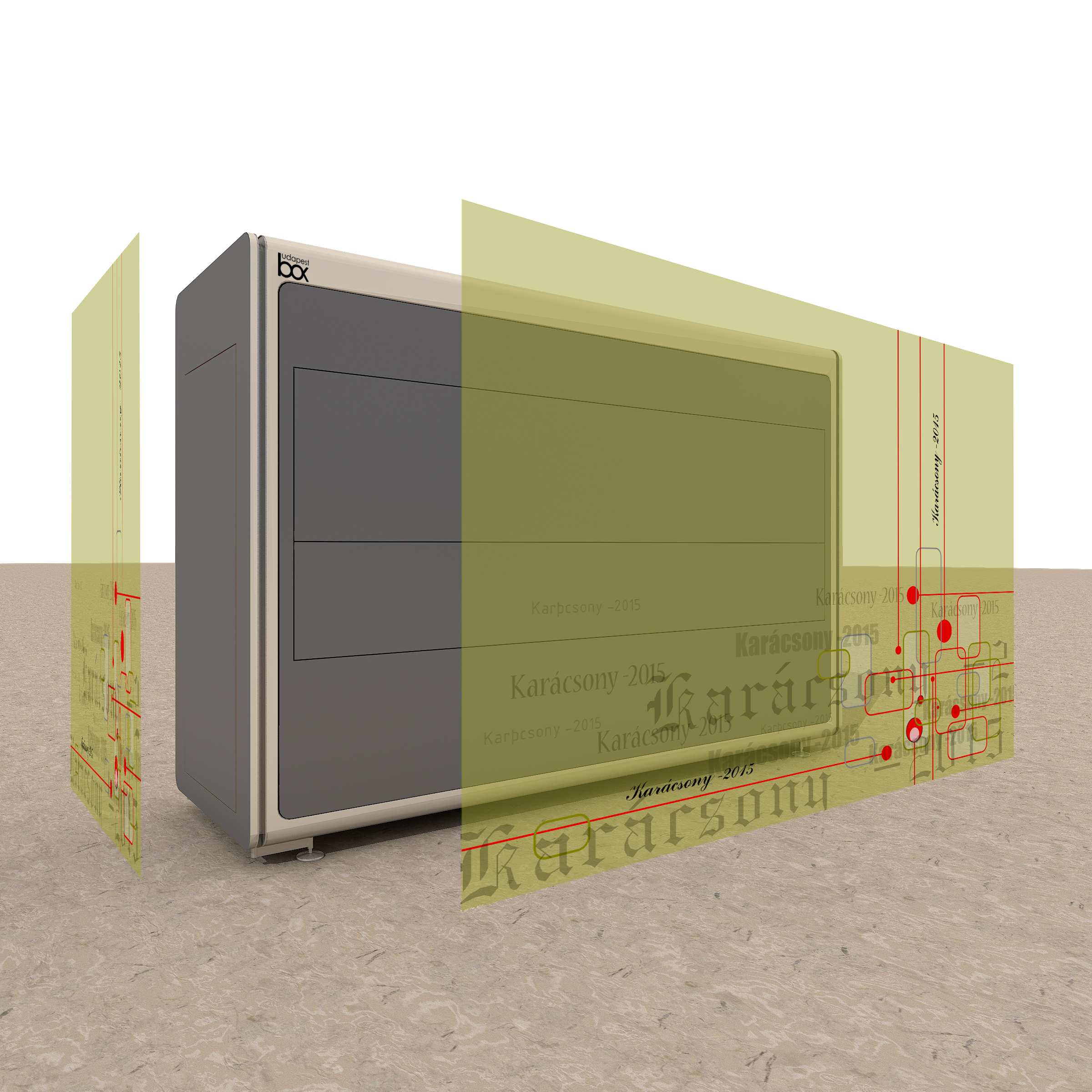
Formally, the pavilion is conceived as a neutral yet precise architectural object. Large, uninterrupted external surfaces allow for graphic application and contextual branding, enabling the system to respond visually to different urban settings, events, or cultural contexts without altering its structural logic.
Budapest Box proposes a contemporary model for temporary urban architecture—one that balances flexibility and standardisation, technical performance and spatial clarity, and architectural identity with infrastructural efficiency.
As all of our designs, our Budapest Box competition entry is also copyright protected.